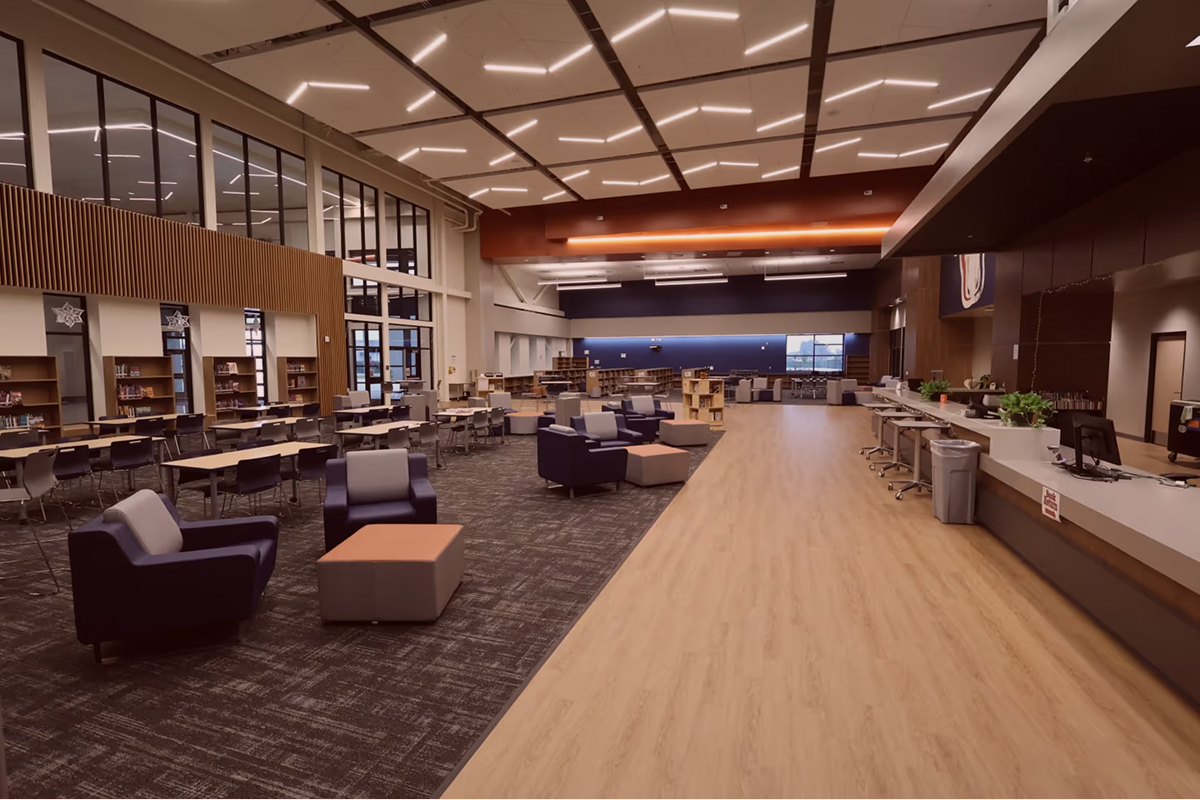


There is no single best commercial flooring material. The right choice depends on traffic volume, moisture exposure, hygiene requirements, acoustics, and budget. The five materials that dominate institutional projects, luxury vinyl tile, rubber, sheet vinyl, polished concrete, and epoxy, each win under different conditions. Here is how they compare side by side, and how to match the material to your facility.
Use the table for the quick decision; read on for where each material genuinely earns its place.
LVT is the most versatile commercial flooring material available, which is why it dominates schools, offices, and senior living. It delivers the look of wood or stone with the durability of resilient flooring, installs in modular tiles or planks that allow damaged sections to be swapped individually, and maintains easily with no waxing or stripping. A quality commercial LVT with a thick wear layer lasts 15 to 20 years under heavy traffic. Choose LVT when you want design flexibility, easy maintenance, and a mid-range budget, it is the default starting point for most institutional projects.
Rubber flooring is the top choice where safety, sound control, and longevity matter most. It is naturally slip-resistant, absorbs impact to reduce injury and fatigue, and dampens noise better than any other resilient material, which is why it dominates healthcare corridors, fitness and recreation spaces, and senior living. It is also among the longest-lasting options, routinely reaching 20 to 30 years. The trade-offs are a higher upfront cost and a more limited aesthetic range. Choose rubber when slip resistance, acoustics, and resident or patient safety are priorities and the budget supports the premium.
Sheet vinyl is the standard for environments where hygiene is non-negotiable. Installed in large rolls with heat-welded seams, it creates a near-seamless surface with no joints for bacteria to harbor, the reason it dominates hospitals, surgical suites, laboratories, and clean rooms. It withstands aggressive daily disinfection and supports the infection-control protocols healthcare facilities are required to follow. Lifespan ranges from 10 to 20 years depending on grade and traffic. Choose sheet vinyl when infection control, seamless installation, and chemical resistance are the deciding factors.
Polished concrete offers the lowest lifecycle cost of any commercial flooring, because it uses the slab you already have. Properly densified and sealed, it resists heavy rolling loads, never needs replacement in the way a covering does, and can last 20 to 40 years or more with minimal maintenance. It suits warehouses, government buildings, retail, and high-traffic lobbies where durability outweighs warmth or acoustics. The trade-offs are hardness underfoot, limited sound absorption, and a more industrial aesthetic. Choose polished concrete when longevity, load resistance, and the lowest long-term cost are the goal.
Epoxy and urethane cement are fluid-applied systems that cure into a seamless, chemical-resistant surface. They are built for the harshest environments, commercial kitchens, industrial floors, and laboratories, where grease, heat, moisture, and aggressive cleaning would destroy other materials. Urethane cement in particular handles thermal shock and constant wet conditions that defeat standard epoxy. Both install seamlessly and clean easily, with a 10 to 20 year service life under heavy use. Choose epoxy or urethane cement when chemical resistance, seamlessness, and extreme-condition durability are required.
The fastest way to narrow the field is to start with your facility's single biggest constraint:
Most institutional buildings use more than one material, sheet vinyl in clinical zones, LVT in offices and classrooms, rubber in corridors and gyms, polished concrete in lobbies. The right specification is rarely one material; it is the right material in each space.
The right commercial flooring decision comes down to knowing your space, its traffic, its hygiene requirements, its budget cycle, and how long you need the floor to last. That's a conversation, not a spec sheet.
RJ Commercial Flooring has installed every material in this guide across Northern California schools, hospitals, government buildings, and senior living communities for 50 years. We don't recommend the most expensive option, we recommend the right one for each space, and we back every installation with ASTM F2170 moisture testing before we install so the floor you choose performs for its full service life.
Request a free project consultation, we serve Sacramento, Modesto, Stockton, Fresno, and 10 Northern California counties.
Let RJ help you create safer, smarter, and more durable leaming spaces.
.svg)