

Commercial flooring in Sacramento must comply with California Title 24 energy standards, ADA slip-resistance requirements, CALGreen indoor air quality regulations, and ASTM moisture testing protocols. For schools, healthcare facilities, government buildings, and other institutional environments, flooring selection directly impacts lifecycle cost, legal liability, operational downtime, and long-term facility performance.
As a Northern California institutional contractor headquartered in Modesto, RJ Commercial Flooring specializes in code-compliant flooring systems engineered specifically for Sacramento’s climate, subfloor conditions, and public-sector facility requirements. Our work as a commercial flooring contractor in Sacramento covers schools, healthcare, government and senior living facilities across the region.
Commercial flooring installations in Sacramento typically require compliance with:
Failure to address these standards can result in:
| Compliance Category | Standard | Why It Matters |
|---|---|---|
| Slip Resistance | DCOF ≥ 0.42 | Reduces slip-and-fall liability |
| Kitchens & Grease Areas | DCOF ≥ 0.55, Oils and Greases | Manufacturer declaration required where oil or grease is present |
| Moisture Testing | ASTM F2170 | Prevents adhesive failure |
| Indoor Air Quality | CALGreen / FloorScore | Required for public facilities |
| Accessibility | ADA Compliance | Prevents transition trip hazards |
| Energy Efficiency | Title 24 | Supports lighting efficiency compliance |
One of the biggest mistakes national contractors make is treating Sacramento like a generic commercial flooring market.
It is not.
Sacramento’s climate creates unique flooring risks due to:
These environmental conditions significantly impact:
In Sacramento K-12 campuses and government facilities, HVAC systems are frequently powered down during:
This creates rapid temperature spikes inside buildings.
As slab temperatures rise, moisture vapor emissions accelerate through the concrete substrate.
When low-performance adhesives are used:
This is one of the most common causes of commercial flooring failure in the Sacramento region.
At RJ Commercial Flooring, every Sacramento institutional flooring project begins with our proprietary Central Valley Moisture Risk Protocol™.
This process includes:
If slab RH exceeds 85%, we specify:
This significantly reduces long-term failure risk.
Sacramento is the center of California regulatory enforcement.
Commercial flooring that fails to comply with:
Many facility managers overlook the relationship between flooring and California energy compliance.
Under Title 24, commercial buildings must meet strict lighting-efficiency standards.
Floor color and finish directly affect:
Higher Light Reflectance Value (LRV) flooring systems help:
This is particularly important for:
Learn more about:
Public-sector facilities in Sacramento increasingly require:
At RJ Commercial Flooring, we specify compliant materials engineered for:
These standards are especially critical in occupied renovation projects where indoor air quality directly impacts:
Explore:
Slip-and-fall incidents remain one of the largest liability risks in commercial facilities.
According to the National Floor Safety Institute, flooring-related falls account for millions of emergency room visits annually.
For Sacramento institutions, compliance with Dynamic Coefficient of Friction (DCOF) standards is essential.
Dynamic Coefficient of Friction (DCOF) measures the slip resistance of a walking surface while a person is already in motion.
Under ANSI A326.3:
Learn more in our detailed guide:
Commercial Flooring Safety & DCOF Standards
Certain facility zones require enhanced traction engineering.
| Facility Zone | Primary Risk | Recommended Flooring |
|---|---|---|
| Entryways | Rain & moisture intrusion | Textured LVT / Walk-off systems |
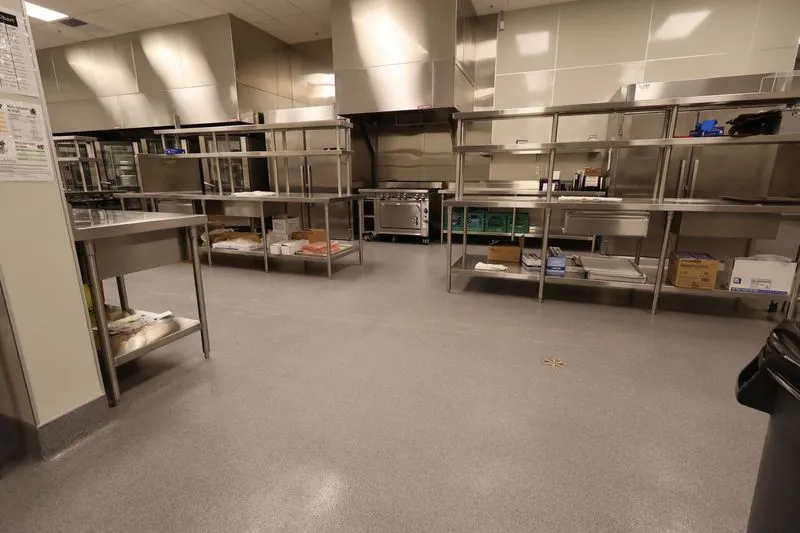
| Commercial Kitchens | Grease contamination | Aggregated safety flooring |
| Healthcare Corridors | Rolling loads & falls | Rubber / Sheet Vinyl |
| School Cafeterias | Spills & impact traffic | High-traction LVT |
| Public Restrooms | Standing moisture | Safety Vinyl |
Rather than applying high-traction materials everywhere, we engineer targeted Safety Zones™ based on:
This improves:
After decades serving Northern California institutional facilities, we repeatedly see the same preventable failures.
The most common issue in Sacramento.
Typically caused by:
Transitions exceeding ADA thresholds create:
Using residential-grade or light-commercial materials in:
Polished or improperly maintained surfaces often fail slip-resistance requirements in wet conditions.
Improper leveling causes:
Different Sacramento facilities require different flooring systems.
There is no universal material.
Related resources:
Sacramento facilities face fundamentally different conditions than coastal California environments.
Contractors unfamiliar with Central Valley conditions often overlook:
At RJ Commercial Flooring, our Northern California installation teams specialize in:
We manage:
RJ Commercial Flooring installs institutional flooring across 27 counties in Northern and Central California, including Sacramento. Talk to us about Title 24, CALGreen, slip resistance and moisture testing before work begins.
Talk to RJ Commercial FlooringYes. ASTM F2170 moisture testing is essential in Sacramento because Central Valley heat and slab vapor emissions can cause adhesive failure, bubbling, and flooring delamination if moisture levels are not properly controlled before installation.
Premium LVT, rubber flooring, and modular carpet tile are among the best flooring options for Sacramento schools because they provide durability, lower maintenance costs, strong acoustic performance, and resistance to rolling-load damage.
Homogeneous sheet vinyl and rubber flooring are preferred for healthcare environments because they support infection control, provide seamless installation capability, and withstand heavy traffic and chemical exposure.
The most important safety benchmark is Dynamic Coefficient of Friction (DCOF). For standard interior floors, ANSI A326.3 recommends a minimum DCOF rating of 0.42 to reduce slip-and-fall risks.
High-performance commercial flooring systems can last 15 to 20 years for LVT, 20 to 30 years for rubber flooring, and 10 to 15 years for carpet tile, depending on maintenance protocols and traffic conditions.
Commercial flooring failures are expensive, disruptive, and often preventable.
At RJ Commercial Flooring, we engineer flooring systems specifically for:
Whether you are renovating:
Our specialists evaluate:
Let RJ help you create safer, smarter, and more durable spaces for schools, hospitals, government buildings, and senior living communities.